

Imagine replacing your company website that has grown over the years. A project that normally takes weeks or months of planning, development, and testing. We took this step and completed it in less than 48 hours. Driven not by a large development team, but by an Artificial Intelligence.
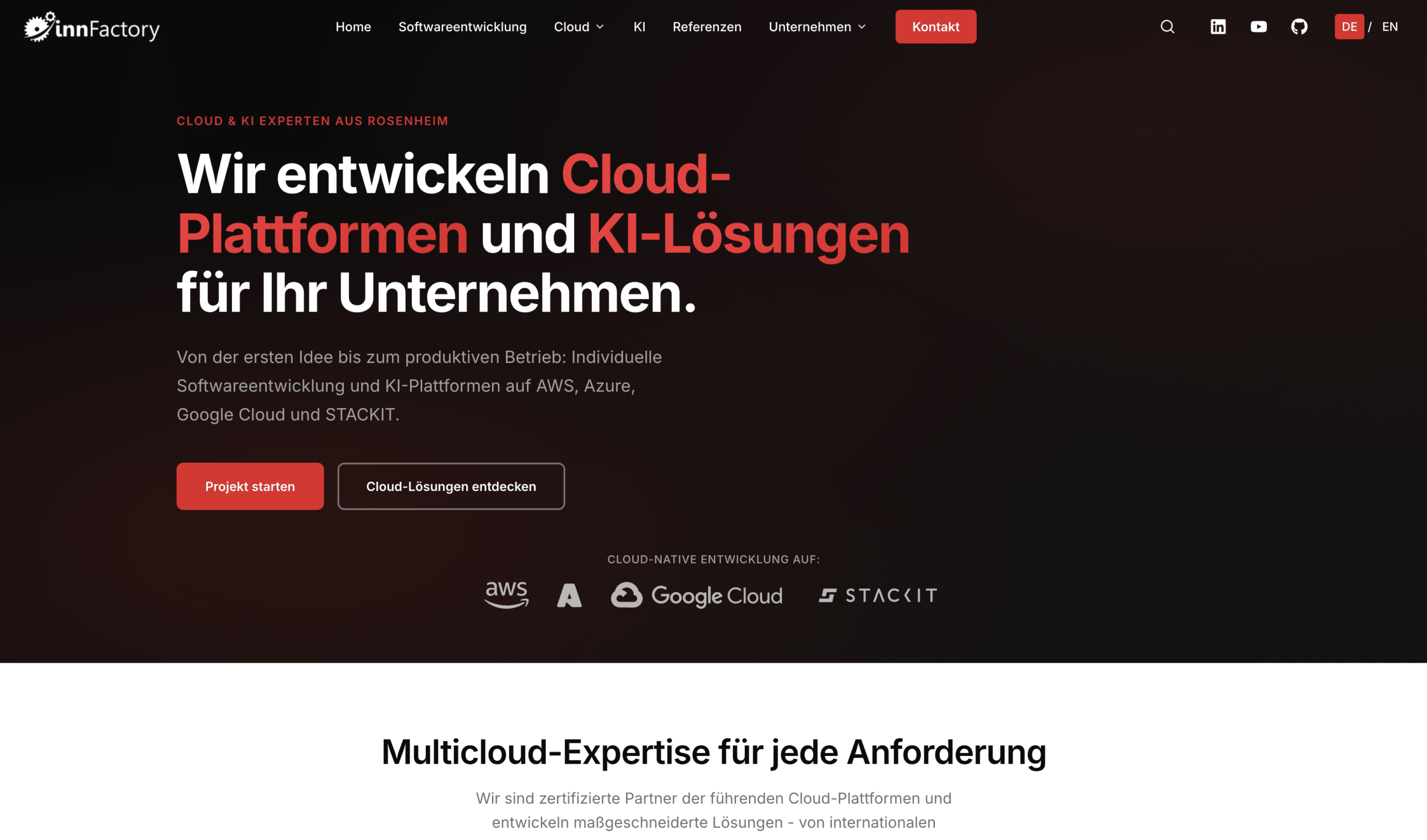
On January 16, 2026, we started a daring experiment: Can Claude 4.5 Opus, one of the most advanced language models, rebuild our entire innFactory.de WordPress website? What began as a technical experiment culminated in a complete go-live on January 18, 2026. The result is not just a new website, but a paradigm shift that raises the strategic question: Does this development herald the end of traditional Content Management Systems like WordPress?
In this post, we give you an exclusive insight into the process, the technology used, and the strategic advantages we were able to realize.
The Process: From Strato vServer to Go-Live in Under 48 Hours
The kick-off was actually only intended as a proof-of-concept. In a sparring session with me as Product Owner, our internal AI framework OpenCode, based on Claude 4.5 Opus via GitHub, took over the complete planning and implementation. The central challenge: to create a fully functional, more performant, and future-proof website without endangering our valuable SEO ranking.
Our technology stack for this project is radically modern:
- The AI Partner: Claude 4.5 Opus, orchestrated through our tool OpenCode, acted as a planning and executing co-developer.
- The Foundation (SSG): Hugo, a blazing-fast Static Site Generator, was chosen as the basis for the new site.
- The Infrastructure (Cloud & Git): We migrated from a Strato vServer to our highly available Google Kubernetes Engine (GKE) Cluster and established a GitOps workflow via GitHub and GitHub Actions.
The process was remarkably efficient: OpenCode and Claude analyzed the existing structure, designed the new architecture, wrote the code, and migrated the content. One of the most critical tasks – securing the SEO ranking – was also handled by the AI. Claude independently searched Google’s index for all our old URLs and created a complete set of 301 redirects to ensure that no link leads to nowhere.
The costs for this entire process amounted to just under 150 EUR for using Claude via GitHub Copilot. While steering the process required my time as Product Owner, the total effort was incomparably lower than with a traditional rewrite.
The Result: A Strategic Realignment
The go-live after just two days was the beginning of a new reality for our online presence. The improvements were immediately noticeable and go far beyond a simple redesign.
Performance and SEO at a New Level
Thanks to Hugo’s static architecture and operation on our GKE cluster with Google CDN, loading times have dropped dramatically. The real numbers from Google PageSpeed Insights from January 18, 2026, impressively underpin this:
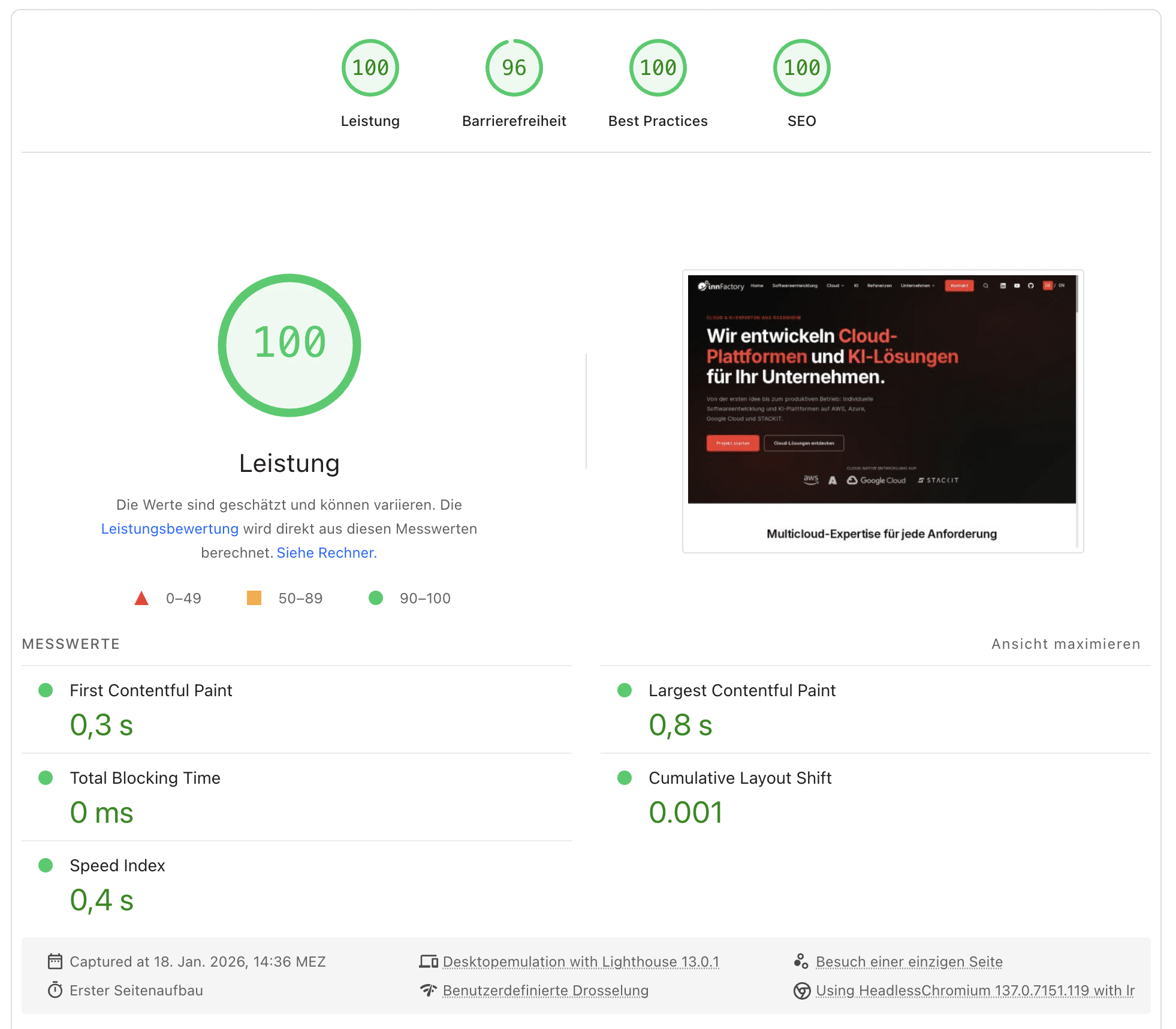
- First Contentful Paint: 0.3 s
- Largest Contentful Paint: 0.8 s
- Total Blocking Time: 0 ms
- Cumulative Layout Shift: 0.001
- Speed Index: 0.4 s
These perfect scores not only improve user experience but are also a crucial ranking factor for search engines.
Farewell to CMS, Plugins, and Cookie Banners
Perhaps the biggest revolution is happening behind the scenes. We no longer have a traditional CMS. There are no WordPress logins, no constant plugin updates, and no security vulnerabilities from outdated extensions.
- Management via Git: Content and code are now centrally managed via GitHub.
- No Cookies, No Banner: Dynamic features like the contact form are handled through a lean API written in Go, which also abstracts our analytics tracking. As a result, we need no cookies and therefore no cookie banner.
- Global Reach: Translations are automatically created by AI agents, enabling fast and cost-effective global scaling.
An MVP with Strategic Outlook
As is common in agile software development, we consider the new website a Minimum Viable Product (MVP). It’s not yet 100% perfect – one text or another will be refined in the coming weeks. But it’s already a quantum leap compared to the old site and provides the perfect foundation for continuous development. The performance far exceeds our old site.
We will now gather experience with innfactory.de over the coming weeks before applying this proven process to our second website, innfactory.ai.
Traditional CMS vs. AI-Powered Approach: A Comparison
| Criterion | Traditional CMS (e.g., WordPress) | AI-Powered Static Site Approach (Our Model) |
|---|---|---|
| Performance | Moderate to slow, depending on plugins & hosting. | Extremely fast (Lighthouse Score 100) due to static nature and CDN. |
| Security | High, but constant updates for core, themes & plugins needed. Large attack surface. | Maximum security. No database, no server-side code execution on the frontend. |
| Costs | License costs, hosting, developers for customizations, maintenance contracts. | Low API costs for AI, hosting on existing infrastructure, minimal development effort. |
| Maintenance Effort | High. Regular updates, backup management, performance optimization. | Minimal. No updates, no plugins. Focus is purely on content and code. |
| Content Management | Visual editor (WYSIWYG), easy for non-technical users. | Code-based (Markdown in Git), efficient for teams, full versioning. |
| Flexibility | Limited by the plugin ecosystem. Customizations are often complex. | Unlimited. Pure code base enables any conceivable function via APIs. |
Conclusion: A Glimpse into the Future of Web Development
So is WordPress really dead? Time will tell how sustainable this AI-powered approach is in practice. For us, with our clear requirements without complex e-commerce features like a shop, the old, monolithic CMS model is outdated.
The development of dynamic content remains exciting. More complex UIs and highly interactive elements are traditionally more difficult to implement with static site rendering. However, this is where the strength of AI shows: It increasingly manages this complexity better and makes even demanding frontends feasible. One must also acknowledge that complex e-commerce solutions today are full-fledged software projects and have little to do with traditional web design.
Our experiment proves: The combination of AI code generation and modern GitOps workflows is not just a technical gimmick, but a tangible strategic advantage.
Want to learn more about GitOps, GitHub, or the strategic use of AI? Contact us or innFactory. We’re happy to share our experiences. You can obtain GitHub through innFactory via the Microsoft partnership and benefit from our know-how.