

In an increasingly digitalized business world, Artificial Intelligence (AI) plays a decisive role in business success. Especially for mid-sized companies, AI solutions offer the opportunity to optimize processes, strengthen customer relationships, and develop innovative products. However, the full benefit of AI is often hindered by fragmented data sources and inconsistent integrations. This is where the Model Context Protocol (MCP) comes in – an open protocol that revolutionizes how applications provide context to Large Language Models (LLMs).
What is the Model Context Protocol (MCP)?
The Model Context Protocol, or MCP for short, is an innovative, open protocol that standardizes how applications pass context information to AI models. Think of MCP as the USB-C of the AI world. Just as USB-C provides a unified interface to connect various devices and accessories, MCP enables a unified connection between AI models and various data sources and tools. This simplifies and accelerates the integration of AI into existing systems. Our CompanyGPT solution for enterprises also supports MCP.
Why is MCP Important for Your Company?
Benefits of Standardization
The standardization of AI integrations through MCP offers numerous advantages:
- Reduced Complexity: Instead of developing an individual interface for each new data source, companies can rely on pre-built integrations that are directly compatible with MCP.
- Scalability: MCP makes it easy to expand AI systems without having to fundamentally adapt the infrastructure each time.
- Flexibility in Provider Selection: Companies are no longer tied to a specific language model provider but can freely switch between different providers and technologies.
- Security: MCP implements best practices for securing data integrations, which is essential for protecting sensitive company data.
Eliminating Data Silos
Many companies struggle with data silos – isolated data sources that cannot communicate with each other. MCP breaks down these barriers and enables seamless connections between different systems. This leads to better data integration and allows AI models to access more comprehensive and relevant information. For example, we can connect internal software systems directly to our Company GPT or to an LLM via MCP.
How Does MCP Work?
MCP is based on a client-server architecture that enables flexible and extensible communication between various components.
Core Components of MCP
- Hosts: These are AI applications like our Company GPT, Claude Desktop, or integrated development environments (IDEs) that initiate connections.
- Clients: These maintain a 1:1 connection with the servers within the host application.
- Servers: Lightweight programs that provide specific capabilities via the standardized Model Context Protocol.
- Local Data Sources: Files, databases, and services on the computer that can be securely accessed by MCP servers.
- Remote Services: External systems accessible via the internet, such as third-party APIs.
Communication Flow in MCP
Communication within MCP occurs through various message types handled via the transport layer. MCP supports multiple transport mechanisms, such as standard input and output (Stdio) for local processes or HTTP with Server-Sent Events (SSE) for remote communication. All messages are exchanged in JSON-RPC 2.0 format, ensuring interoperability and extensibility.
Current Developments and Industry Support
MCP Support by OpenAI and Microsoft
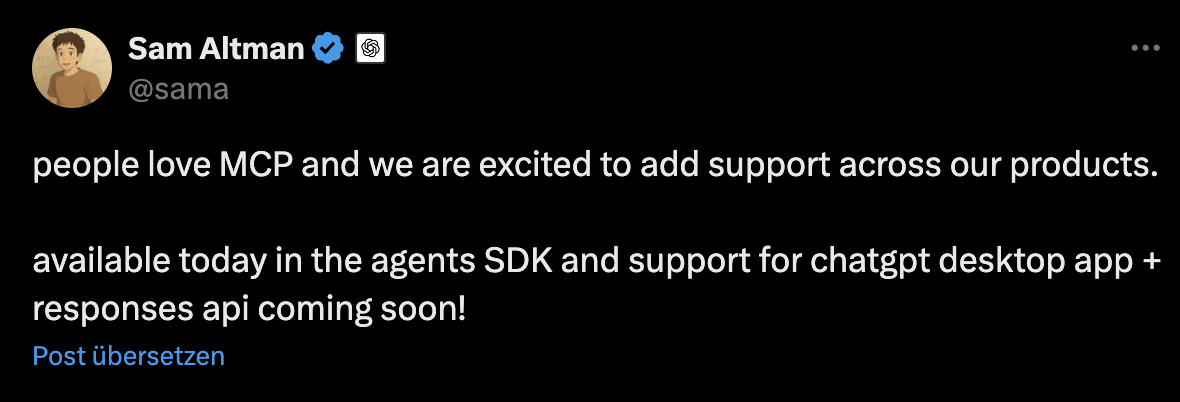
MCP recently reached a significant milestone: OpenAI and Microsoft announced their support for the protocol. OpenAI is integrating MCP into its Agents SDK as well as future versions of the ChatGPT desktop app and the Responses API. Microsoft complements this with the introduction of the Playwright MCP server, which enables AI agents to browse the web and interact with websites.
This support from leading technology companies underscores the relevance and growth potential of MCP. For mid-sized companies, this means increased availability and improved integration options for their AI solutions.
MCP Support in innFactory CompanyGPT
Our GDPR-compliant “ChatGPT” solution for enterprises, which is built on many open-source technologies, already supports the MCP protocol today, allowing AI Agents to be created directly in the CompanyGPT interface and extended with MCP tools.
Implementing MCP in Your Company
Getting Started with MCP
Implementing MCP is straightforward and can begin within minutes. An example for getting started is using the Company GPT client in combination with the Knowledge Graph Memory Server. This allows companies to efficiently manage their knowledge databases and provide AI systems with relevant information.
Integration of MCP Servers and Clients
Companies can choose from a variety of MCP servers depending on their specific requirements. Configuration is done via a simple JSON file where the desired MCP servers are defined. After configuration, data sources can be added and linked, allowing AI systems to access comprehensive and structured information in real-time.
Practical Example
A practical example shows how companies can use their knowledge database. By adding the Knowledge Graph Memory Server to Company GPT, employees can incorporate research papers like “Attention Is All You Need” into the knowledge database. Subsequently, AI-powered analyses and visualizations, such as Mermaid diagrams, can be created to make complex relationships understandable. Additionally, internal systems can also be made very easily accessible via MCP. For example, it would be conceivable to connect certain SAP processes or production machines via MCP, making valuable information available to employees.
Model Context Protocol – The New Standard
The Model Context Protocol (MCP) represents a significant innovation in the field of AI integration, specifically tailored to the needs of mid-sized companies. By standardizing data connections, eliminating data silos, and promoting scalability and security, MCP enables more efficient and effective use of AI systems. With support from industry leaders like OpenAI and Microsoft, as well as a clear roadmap for the future, MCP is well-positioned to fundamentally change how companies use AI. Companies that adopt MCP early can secure a decisive competitive advantage and fully exploit the potential of Artificial Intelligence. Additionally, our Company GPT solution already offers the ability to integrate MCP servers today. After Microsoft and OpenAI announced they would also rely on MCP, despite it being developed by Claude, we expect it to become the industry standard.