

On November 25, 2024, Anthropic open-sourced the Model Context Protocol (MCP). Two years later, the official SDKs count more than 5 billion downloads, 4.5 billion of them in the past year and more than 700 million in the last 30 days alone. More than 2,500 people have contributed to the project. For the anniversary, lead maintainers David Soria Parra and Den Delimarsky took stock: Two Years of MCP Builders.
This article explains what changed in the protocol during its second year, which features were only just announced, and where things are heading in 2027. At the end you will find what IT leaders should prepare now.
In short: In 2026, MCP grew from a developer tool into infrastructure, and as of November 2026 the official SDKs count more than 5 billion downloads. The 2026-07-28 specification makes the core stateless, so MCP servers scale like any other web service. New capabilities arrive as extensions: MCP Apps for user interfaces and Enterprise-Managed Authorization for central sign-in are stable, while Tasks, Events and Skills are in beta. The next specification ships on March 30, 2027, followed by a six-month cadence.
All information is as of November 24, 2026 and based on the official MCP blog and specification.
Two years of MCP at a glance
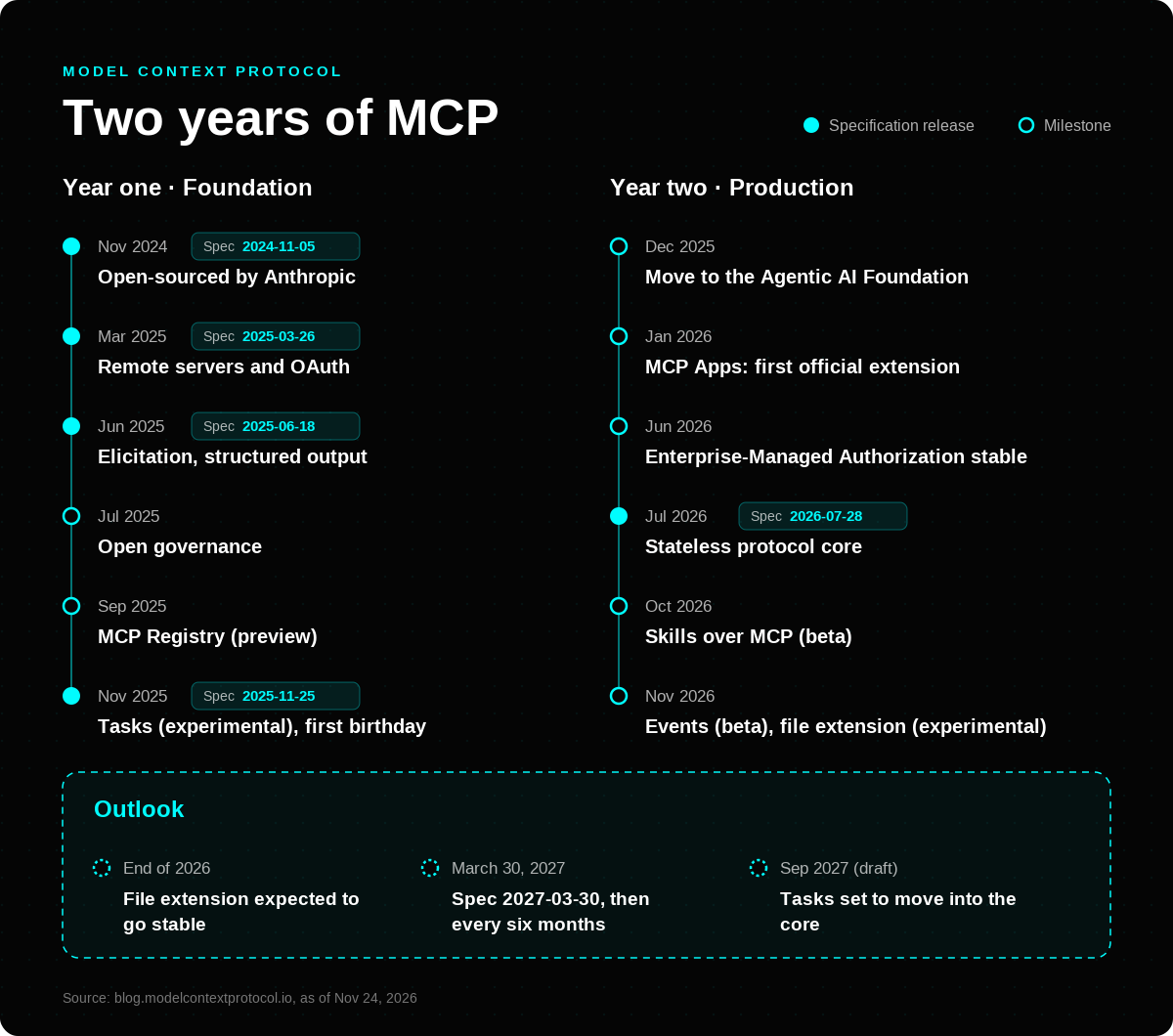
The first year laid the foundation. When we described MCP as the USB-C interface for LLMs in March 2025, the specification for remote servers and OAuth sign-in had just been released. Over the year, follow-up questions to users (elicitation), structured output and a registry for public servers followed. In July 2025, the project adopted formal governance that lets anyone propose changes.
In December 2025, MCP moved into the Agentic AI Foundation under the Linux Foundation. Since then, the protocol no longer belongs to a single vendor, much like Kubernetes, PyTorch or Node.js. For companies building their integrations on MCP, one thing matters most: the standard no longer depends on one model provider’s product strategy.
The second year was about running MCP in production. Thousands of teams did exactly that and showed where the protocol fell short. The key changes of the year came straight from that experience.
How widely is MCP used after two years?
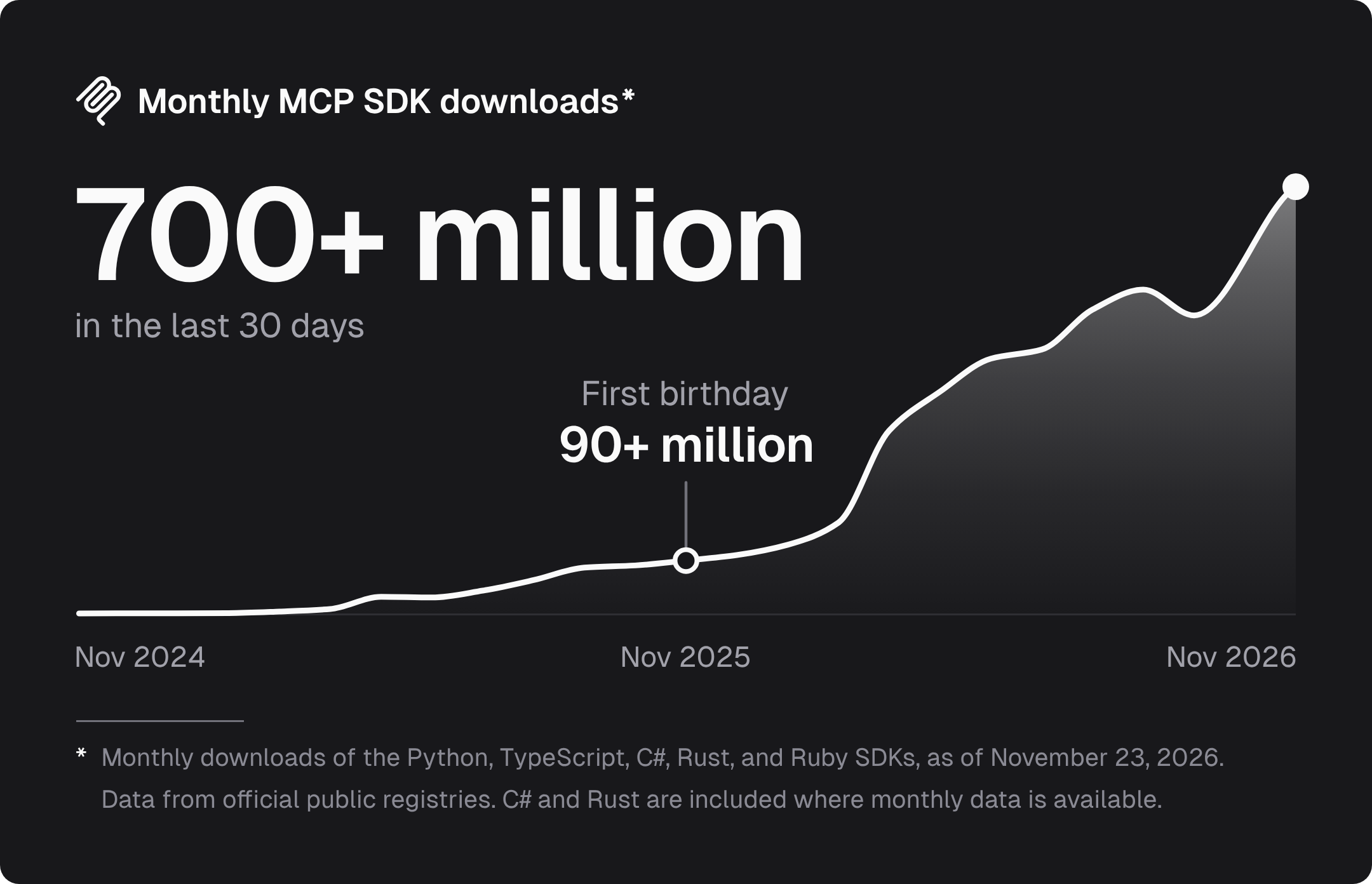
Chart: Model Context Protocol Blog, licensed CC BY 4.0
In November 2025, at the first birthday, the SDKs stood at more than 90 million downloads a month. In the 30 days up to November 23, 2026, it was more than 700 million. By July, the TypeScript and Python SDKs had each passed one billion downloads. Downloads do not count agents in production, but they show how deeply MCP now sits in build pipelines and dependency trees.
More interesting than the curve is who builds MCP in. Blender has an official MCP server, and DaVinci Resolve Studio and Cinema 4D have shipped built-in servers since September 2026. ROS MCP lets you direct robots running the Robot Operating System in natural language, without changing any robot code. At Berkeley Lab, researchers use the TEM Agent to operate an electron microscope through MCP just by describing what they need. In everyday development, an agent uses the same protocol to pick up tickets in Linear, pull current library docs from Context7, check its work with the Chrome and Safari browser tools and deploy to Cloudflare. Observability vendor Honeycomb reports that nearly 20 percent of all monthly interactive queries now come from agents.
What does the MCP specification 2026-07-28 change?
The 2026-07-28 specification makes MCP stateless. Until then, MCP was a stateful protocol. Client and server negotiated version and capabilities when connecting, the server issued a session ID, and every following request had to reach the same server instance. Scaling an MCP server horizontally meant sticky sessions or shared storage for session state. On serverless platforms, that was painful.
According to the maintainers, the 2026-07-28 specification is the largest revision since launch, and it cleans this up. Every request now describes itself:
POST /mcp HTTP/1.1
MCP-Protocol-Version: 2026-07-28
Mcp-Method: tools/call
Mcp-Name: search

{"jsonrpc":"2.0","id":1,"method":"tools/call",
 "params":{"name":"search","arguments":{"q":"otters"},
 "_meta":{"io.modelcontextprotocol/clientInfo":{"name":"my-app","version":"1.0"}}}}
The key changes at a glance:
- No handshake, no session: The
initialize/initializedexchange and theMcp-Session-Idheader are gone. Protocol version, client and capabilities travel with every request. If a client wants to know a server’s capabilities up front, it can optionally callserver/discover. - Routing on headers:
Mcp-MethodandMcp-Nameare mandatory. Gateways, rate limiters and web application firewalls can route, meter and authorize on them without parsing the JSON body. - Follow-up questions without an open stream: If a tool needs a confirmation mid-call, the server responds with
input_required, and the client retries the call with the answers attached. These Multi Round-Trip Requests (MRTR) replace the old server-to-client requests. Supabase, for example, uses them to confirm the cost of a new project before creating it. - Cacheable tool lists: Lists carry
ttlMsandcacheScopeand come in a fixed order. Clients can cache tool catalogs, and the model provider’s prompt cache stays stable across reconnects. That saves tokens. - Hardened sign-in: Clients must validate the issuer per RFC 9207, credentials are bound to the issuer that minted them, and Dynamic Client Registration (DCR) is deprecated in favor of Client ID Metadata Documents (CIMD).
- Predictable deprecations: Roots, Sampling, Logging and the legacy HTTP+SSE transport are deprecated. A new policy guarantees at least twelve months of transition for every deprecation.
Stateless does not mean applications can no longer have state. If a server needs state across calls, a tool returns an explicit handle that the model sends back with the next call. The maintainers consider this more robust than state hidden in the transport, because the model sees the handle and can pass it between tools.
For operations, this means an MCP server is now an ordinary HTTP service. It runs behind a round-robin load balancer, on Cloud Run, Lambda or Cloudflare Workers, and a gateway in front of it can decide per tool who may call it. At release, the TypeScript, Python, Go and C# SDKs supported the new version. Since then, the Rust and Ruby SDKs have also reached the top tier (Tier 1). Cloudflare supported the new version in its Agents SDK from day one, and AWS offers it in Amazon Bedrock AgentCore.
What MCP extensions are there?
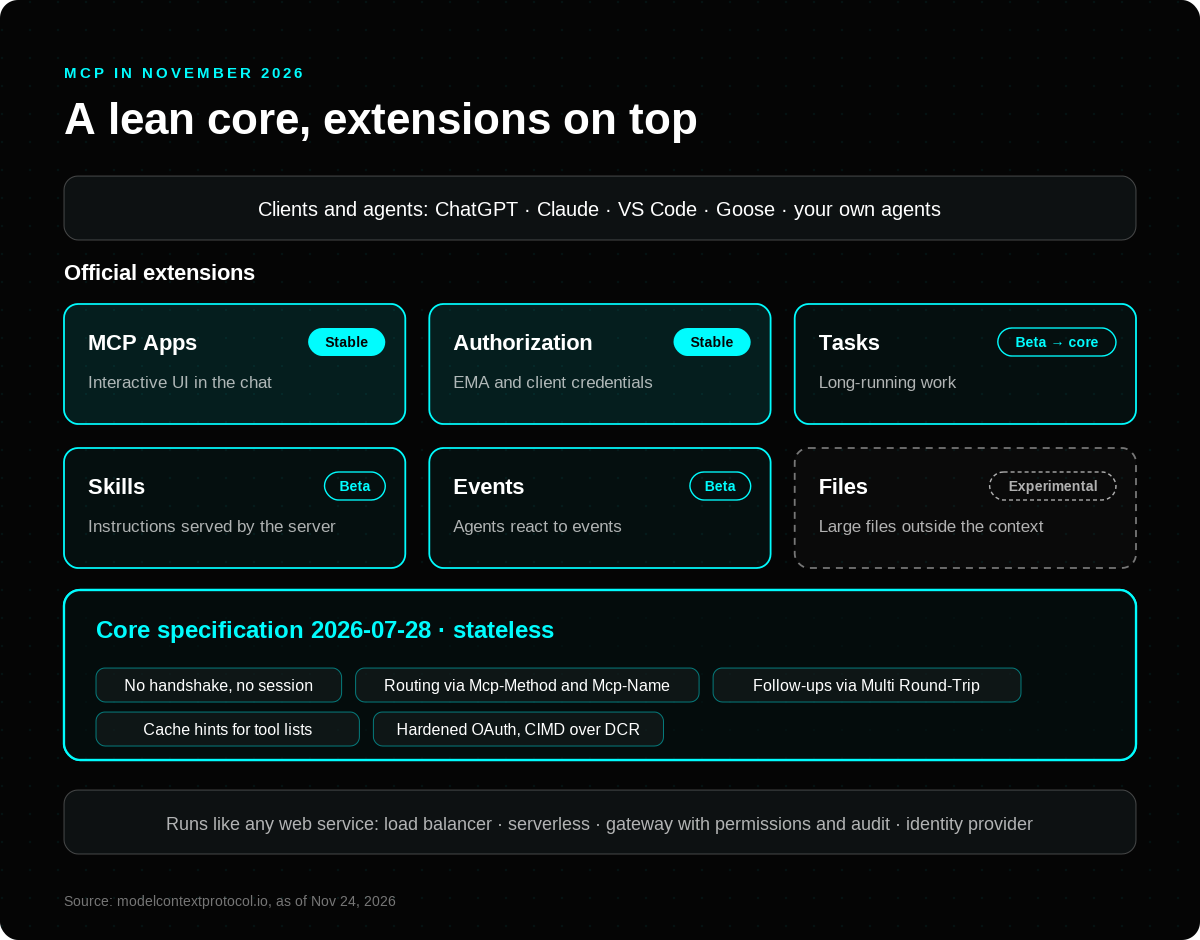
The second big decision concerns the architecture of the standard itself. New capabilities no longer go straight into the core but ship as official extensions with their own maturity level. An extension starts as experimental, becomes beta through a proposal (SEP), and then either becomes stable or moves into the core. Stable extensions only change with a new core version. Clients and servers negotiate per request which extensions they understand. If you don’t need an extension, you ignore it.
| Extension | Purpose | Maturity (Nov 2026) | Status |
|---|---|---|---|
| MCP Apps | Interactive interfaces in the chat | Stable | first official extension, January 2026 |
| Enterprise-Managed Authorization | Central sign-in through the identity provider | Stable | stable since June 2026 |
| OAuth Client Credentials | Sign-in for services without a human, such as CI pipelines | Stable | changes only with a new core version |
| Tasks | Long-running work with status polling | Beta | set to move into the core in September 2027 per draft SEP-3570 |
| Events | Subscribe to events in upstream systems | Beta | beta since early November 2026 |
| Skills over MCP | Ship instructions from the server | Beta | public beta in Claude since November 24, 2026 |
| Server Cards | Read a server’s metadata before connecting | Beta | destination not yet decided |
| File uploads | Move large files outside the context | Experimental | draft November 2026, stable targeted by end of 2026 |
MCP Apps: interfaces instead of walls of text
MCP Apps became the first official extension in January 2026. A tool returns not just text but an interactive interface that the client renders in a sandboxed iframe right in the chat: dashboards, forms, maps, approval dialogs. The extension builds on MCP-UI and OpenAI’s Apps SDK and works in ChatGPT, Claude, Goose and VS Code. Build the interface once, and it works in all of these clients. We compared it with Google’s A2UI in A2UI vs. MCP-UI.
Enterprise-Managed Authorization: sign in once, everything connected
For companies, sign-in has been a bottleneck. Every person had to connect every MCP server individually via OAuth, IT had no central control, and personal and work accounts were easy to mix up. Since June 2026, Enterprise-Managed Authorization (EMA) is stable. The company’s identity provider decides centrally, based on groups, roles and conditional access policies, who may use which server. Employees sign in once and have all approved servers connected.
Under the hood, the client exchanges an Identity Assertion JWT Authorization Grant (ID-JAG) obtained during single sign-on for an access token from the MCP server. Okta is the first supported identity provider. On the client side, Claude, Claude Code, Cowork and VS Code support the extension, and on the server side Asana, Atlassian, Canva, Figma, Linear and Supabase, among others. For services without a human in the loop, such as CI pipelines, the OAuth Client Credentials extension is stable as well.
Tasks and Events: agents that work without a prompt
Until now, MCP was request-driven: someone asks, the server answers. Two extensions change that. Tasks, contributed by AWS, covers long-running work, with status polling and input during execution. A server can even run a full agent loop in the background while the client keeps working. Tasks is in beta. A draft proposal (SEP-3570) would move Tasks into the core with the September 2027 release. In Claude and Claude Code, Tasks and Elicitation have been generally available since November 24, first for the Pro, Max and Ultra plans, with the rollout to Team and Enterprise to follow.
Events reached beta in early November 2026. A client subscribes to events in upstream systems, such as a new email, a push to a repository or a P1 incident for a specific service, and an agent reacts, even when nobody is at the keyboard. Servers can deliver events in three ways: polled by the client, pushed over an open connection, or as a signed webhook. A cursor ensures that nothing is lost after a restart.
The security model of Events is remarkably clear. Event payloads count as untrusted because they can carry prompt injection. Servers should send only what is needed, and permissions are checked at subscription time and again at every delivery. Above all, receiving an event never authorizes the agent to do anything: every follow-up call goes through normal authorization again. If you let agents react to events, enforce exactly these rules in your own architecture too.
Skills over MCP: the knowledge moves to the server
Having a tool does not mean using it well. Skills over MCP lets a server ship instructions alongside its tools: a folder with a SKILL.md in the Agent Skills format plus optional supporting files. The client loads the instructions only when it needs them. Every file carries a SHA-256 digest, and the host decides whether to load a skill into the context after approval.
For the anniversary, on November 24, 2026, Anthropic launched Skills over MCP as a public beta in Claude and Claude Code. Shopify, HubSpot and Atlassian already ship instructions for their tools this way. In October 2026, Anthropic also contributed the skill format itself as the Agent Skills project to the Agentic AI Foundation, which now hosts ten projects.
We know this problem from practice. When we connected our internal wiki as an MCP server, the agent first tried to load wiki pages via web fetch and built links that did not exist. So we wrote the rules into the tool descriptions and added a skill to the agent setup as well. With Skills over MCP, the server will ship this knowledge itself, versioned in the place that knows the tool best. How skills and MCP servers are packaged together is covered in our article on Agent Plugins.
Files: large files that bypass the context
Saving a PDF from the chat to cloud storage or pulling a large CSV into a sandbox: many teams want this, and today everyone builds their own conventions for it. In November 2026, a working group presented a first draft of a file extension. A server marks an argument as a file with x-mcp-file. Small files travel inline, while the client uploads large ones directly to their destination without the model seeing every byte. The extension is still experimental, and the maintainers aim to make it stable by the end of 2026. Anthropic has announced that it will roll out in Claude and Claude Code soon.
Where is MCP heading in 2027?
A fixed release cadence. From 2027, specifications ship twice a year, on the last Tuesday of March and September. The next version, 2027-03-30, ships on March 30, 2027. Planning starts eight months ahead. Two and a half months before release the scope freezes, one and a half months before release Tier 1 SDK betas arrive, and in the final month only critical fixes are allowed. For the March release, that puts the SDK betas at roughly mid-February 2027. A proposal that isn’t ready waits for the next release instead of moving the date. For companies, this means you can put upgrades in the annual calendar.
Agents get their own identity. The official roadmap names five priority areas, and agent identity is one of them. MCP authorization has assumed a person with a browser at consent time. Increasingly, the caller is an agent: a cloud workload with its own identity, acting for a user who isn’t present, or spawning sub-agents with narrower permissions. An Agent Identity working group is forming now. It is meant to bring together DPoP, Workload Identity Federation, the ID-JAG used by Enterprise-Managed Authorization and RFC 8693 token exchange, coordinated with the IETF OAuth and WIMSE working groups. First extensions that bind access tokens to the client that requested them and let cloud agents sign in with their own identity are in progress. That follows logically: once agents start from events without a human, access can no longer hang off a person’s account.
One transport for everything. Today, local servers speak stdio and remote servers Streamable HTTP, and every HTTP feature needs a second design for stdio. The roadmap aims for a single transport: HTTP, spoken over stdin and stdout for local servers. ETag-based caching is planned on top, including for tool call results.
From chat to background agents. Tasks, Events and the file extension point in the same direction. MCP no longer just connects a chat window to tools. It is becoming the interface for agents that react to events on their own and work for hours. That raises the stakes for governance: who may point which agent at which event, with what budget, and who can see afterwards what happened? Our analysis of the last mile in mid-sized companies shows that this is exactly where projects stall today, not at the protocol.
Security becomes a process. As adoption grows, so does the attack surface. In October 2026, two critical vulnerabilities in the MCP Inspector, the official developer testing tool, were published: a malicious server or MCP App could use it to run commands on the developer’s machine. Version 1.0.3 fixes both. A proposal (SEP-3543) would make the project a CVE Numbering Authority so it can catalog vulnerabilities itself. And since November, the project has defined how actively exploited vulnerabilities reach the Linux Foundation’s steward under the EU Cyber Resilience Act. Cloud providers are following suit: since November, AWS WAF discovers MCP endpoints across your organization, lists undocumented MCP servers as shadow APIs and blocks malformed MCP messages.
The registry remains in preview. More than a year in, the official MCP Registry is still in preview, and breaking changes or data resets may occur before general availability. If you pull servers from it, review them like any other dependency.
More ideas in the workshop. Experimental extensions include interceptors that validate and transform tool calls, tool annotations for action metadata and trust, and file system operations on resources. Whether they become stable extensions is up to the working groups.
What should companies do now?
- Take inventory. Which MCP servers run in your company, which protocol version do they speak, and who operates them? In many organizations the honest answer is: unknown. Without this list, you can neither migrate nor secure anything. On AWS, the WAF now finds such shadow servers automatically. Better still is an inventory without gaps in the first place.
- Plan the move to 2026-07-28. Your own servers that rely on session IDs, sampling or the legacy HTTP+SSE transport need a migration path. The transition period is at least twelve months. Also plan the switch from Dynamic Client Registration to Client ID Metadata Documents.
- Centralize sign-in. Check whether your identity provider and your clients support Enterprise-Managed Authorization. Where they don’t yet, put a central control point in front of your MCP servers instead of having every person connect every server individually.
- Put a gateway in front of your servers. With the new headers, a gateway can decide per tool who may call it and log every call. Our AI Gateway Cenodia bundles MCP servers behind one sign-in, checks tool arguments and results with guardrails, and records every call with person, tool, cost and status.
- Introduce events and skills only with rules. Event payloads are external input and can carry prompt injection. Skills are instructions to your model and deserve the same treatment as code: reviewed, versioned and approved. Our notes on MCP and security still apply. Also keep developer tools like the MCP Inspector up to date, at version 1.0.3 or later.
- Test the SDK betas in February. If you run your own servers or clients, try the betas for the March release with your integrations. Bugs reported then still make it into the specification.
Conclusion
Two years after launch, MCP is no longer an experiment but the common ground on which agents talk to tools and data. The second year closed the gaps that held back enterprise adoption: scaling, central sign-in and predictable releases. The third year will show whether companies combine the new capabilities for background agents with clear rules for identity, permissions and traceability. The protocol is no longer the bottleneck.
Related articles from our blog:
- AI Harness explained: what turns a model into an agent
- WebMCP: MCP tools directly on websites
- CompanyGPT: your own AI stack with MCP connections to your systems
Want to connect your systems to AI agents via MCP without giving up control over identity, permissions and costs? In our AI strategy consulting we assess your system landscape and plan the first use case with you. Get in touch.
Sources
- Model Context Protocol Blog: Two Years of MCP Builders, Nov 24, 2026
- Model Context Protocol Blog: The 2026-07-28 Specification, Jul 28, 2026
- Model Context Protocol Blog: A More Predictable Release Cycle for MCP, Nov 11, 2026
- Model Context Protocol Blog: Exploring File Uploads and Downloads in MCP, Nov 10, 2026
- Model Context Protocol Blog: Enterprise-Managed Authorization, Jun 18, 2026
- Model Context Protocol Blog: MCP Apps, Jan 26, 2026
- Model Context Protocol: Extensions Overview, Events, Skills, Roadmap (last updated Aug 22, 2026), Registry
- Model Context Protocol Blog: The Official Ruby SDK for MCP Reaches Tier 1, Oct 30, 2026
- GitHub: SEP-3570: promote tasks into the core protocol (draft, Nov 20, 2026), MCP Inspector advisories GHSA-4fc4-wcmh-4g86 and GHSA-6x67-4w4w-9f3w, Oct 21, 2026
- Anthropic: MCP servers can now ship skills, run tasks, and more with Claude, Nov 24, 2026
- Agentic AI Foundation: Four new projects, Oct 22, 2026
- AWS: AWS WAF discovery and protection for LLM, MCP and A2A endpoints, November 2026