

AI, especially LLMs, but also digitalization in general, constantly present companies, teams, and IT departments with new challenges: More data, higher complexity, and the desire for automation to save resources and drive innovation. At the center of this development are automation platforms that connect traditional workflows with modern AI technologies. A particularly flexible and sustainable approach is offered by the open-source tool n8n. In this article, you’ll learn how to efficiently, flexibly, and securely implement even complex, AI-powered automations with n8n.
What is n8n? – The Flexible Answer to Digital Process Diversity
n8n is an open-source workflow automation platform that allows you to connect and automate various tools, data sources, and services via drag & drop. Whether email, databases, web APIs, or messaging services: Over 350 integrations are available to smartly automate traditional business processes (such as lead management, support, marketing) as well as internal data flows, custom reports, or smart notification services in your company.
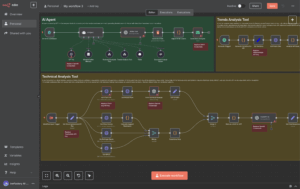
What makes n8n so valuable:
- Data sovereignty and GDPR compliance through self-hosting: Sensitive data remains within your control. You can activate the Community Edition of n8n as an addon to our CompanyGPT, so you can also access the LLMs in STACKIT, Google, or Azure OpenAI for your n8n AI agents.
- Low-code approach: Workflows without code (No-Code) or with a few lines of script (Low-Code) offer an ideal way to map simple and complex business processes, so you don’t need custom development for everything. This way, even non-developers can map their business processes with AI support.
- Extensibility: Should processes reach their limits, they can be used as a basis for a clean implementation in custom software. You can either develop your own n8n modules, custom API calls, and scenarios for very specific business requirements, giving you a smooth transition to custom development with a manageable budget.
AI Workflows with n8n: How Automation and Artificial Intelligence Connect
What are AI Workflows?
Artificial Intelligence in n8n doesn’t just mean generating text or integrating a language model. A true AI workflow consists of multiple steps where data is collected, processed, analyzed, and decisions are made. Usually with the support of modern Large Language Models (LLMs) like GPT-4, Gemini, or open-source alternatives. This way, companies can automate not only repetitive tasks but also tasks that previously required experienced specialists.
A detailed description of AI workflows and their workflow architectures can also be found in the blog at: https://innfactory.ai/ai/tech/digitale-workflows-vs-ki-agenten-so-optimieren-sie-ihre-geschaeftsprozesse-mit-kuenstlicher-intelligenz/
How are AI Workflows Built with n8n?
n8n offers a visual workflow environment with so-called nodes (building blocks) that are logically connected. Each node handles a defined task such as:
- Triggering by a specific event (e.g., new email, form submission)
- Retrieval and preprocessing of data (e.g., database query or HTTP request)
- Passing inputs to an AI model (e.g., OpenAI, DeepSeek, Google Gemini, LLama)
- Post-processing and transmission to other systems (e.g., Slack, Teams, CRM, ticket system)
Example: Automated Analysis and Verification of Incoming PDF Invoices with n8n and AI
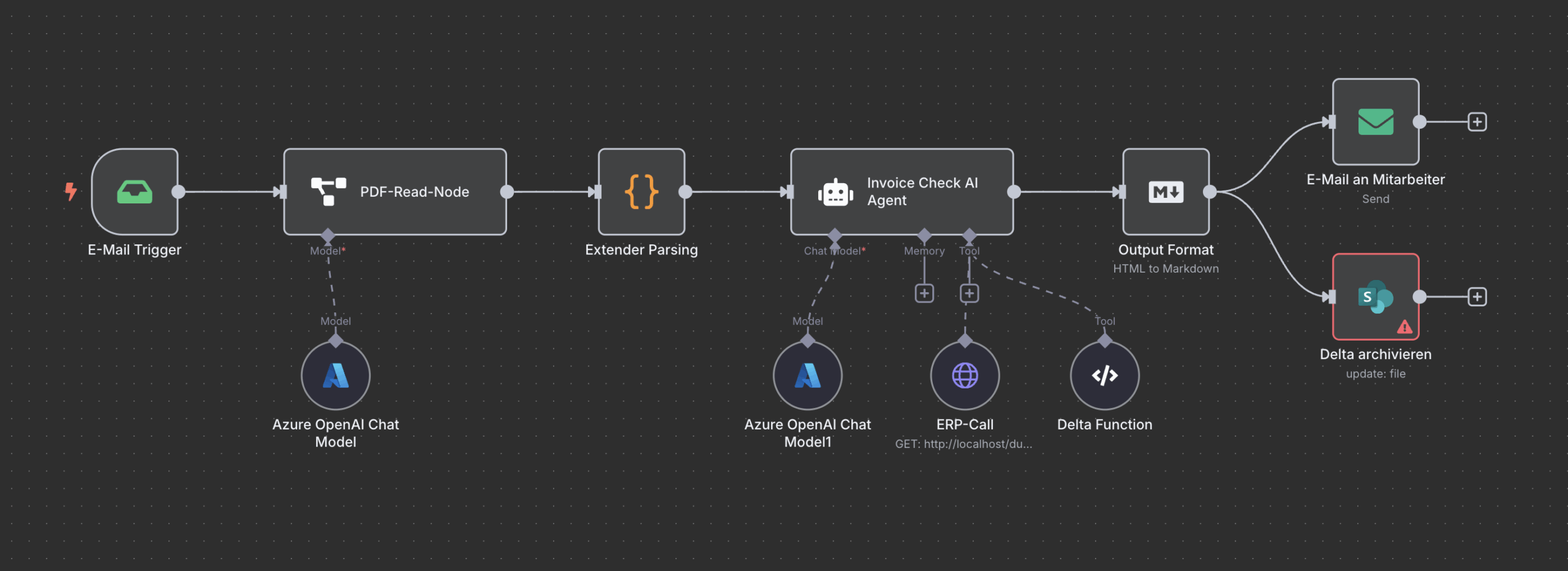
Scenario: A company regularly receives PDF invoices via email. These invoices should be automatically processed, their line items (e.g., articles, prices, quantities) reliably extracted, and then compared with the data of an associated quote from the ERP system. At the end, the responsible clerk receives a delta report, i.e., a list of discrepancies that need to be reviewed.
Here’s how the workflow could be implemented with n8n:
Trigger – Detect Invoice Receipt:
- n8n Node: Email Trigger (IMAP/SMTP)
- As soon as a new email with a PDF attachment arrives in the mailbox, the workflow starts.
Read PDF and Extract Content:
- n8n Node: PDF Read Node (or HTTP Node if an external document service is connected)
- The PDF is extracted from the attachment.
- Text content, tables, or structured data are analyzed using AI text extraction (e.g., Azure AI Document Intelligence, Google Document AI, or open-source models like LayoutLM).
Extract Line Items (AI-powered Parsing):
- n8n Node: Custom Function + AI / NLP API
- The recognized invoice line items (article name, quantity, price, total amount, possibly taxes, etc.) are converted into structured data (e.g., as JSON).
Compare with Quote Data:
- n8n Node: Database Node / API Call to the ERP System
- The quote is searched in the ERP system using the invoice number or customer data, and the quote line items are loaded.
Delta Calculation:
- n8n Node: Function Node or Compare Node
- The extracted invoice line items are compared with those of the quote.
- Differences such as price deviations, missing or additional items are identified.
Generate Delta Report:
- n8n Node: Markdown Node or HTML Report Node
- The result (discrepancies, open questions) is prepared as a clear delta report.
User Notification:
- n8n Node: Email Node, Slack Node, or Microsoft Teams Node
- The clerk automatically receives a notification including the delta report and possibly the original PDF.
(Optional) Automated Filing and Logging:
- n8n Node: Drive Node, SharePoint Node, or S3 Node
- The PDF and analysis results are centrally archived and documented.
Practice: From Simple Automations to Intelligent Multi-Agent Processes
Where are the Greatest Benefits for Companies?
- Cost efficiency & time savings: Repetitive tasks run completely automatically.
- Scalability & flexibility: Adjustments are possible via drag & drop without long development cycles.
- Security & compliance: Hosting remains self-determined within your company through n8n, which is an invaluable advantage especially for GDPR-sensitive processes.
- Establishing new business potential through AI: This enables targeted automation of innovations in support, sales, data analytics, and marketing.
Limits and Best Practices
Despite all the advantages, n8n reaches its limits when:
- very complex, individual system architectures with special performance or compliance requirements exist,
- proprietary business logic needs to be deeply integrated into the backend,
- or the scope of integration goes far beyond standard protocols.
Often, the combination of n8n as an automation orchestrator with tailored custom development is the ideal path.
Trends & Future: Automation and AI as a Strategic Competitive Advantage
AI workflows with tools like n8n (self-hosted) or Make (SaaS) mark the next evolutionary step for digital transformation, as they build the bridge to custom software development and massively facilitate entry into the AI world. With n8n and AI-powered workflows, you transform traditional processes into true intelligence: You combine automation, data sovereignty, and the power of modern language models into a smart, flexible tool for innovative, efficient, and secure business operations. Whether you want to automate a simple task or transform an entire department through AI-powered workflows: With n8n, you’re ready for the future of digital process automation.