

Artificial intelligence is revolutionizing industries and business models. But while we exploit the immense potential of Large Language Models (LLMs), a crucial question comes to the fore: What is the ecological footprint of this technology? While the industry has long speculated about energy consumption, AI company Mistral AI is one of the first to present comprehensive and transparent data. Their detailed life cycle analysis (LCA) shows the real impact of AI and thus provides crucial food for thought for the entire industry.
Mistral Large 2 in Context: Classifying Performance
Before we dive into the environmental data, it’s important to understand the capabilities of Mistral Large 2. This model positions itself as a direct competitor to the most well-known models on the market, such as OpenAI’s GPT-4o and Google’s Gemini 1.5 Pro. In various benchmarks, Mistral Large 2 shows equal or even superior performance in areas such as logical reasoning, code generation, and multilingual processing. It’s therefore not a “lightweight” whose efficiency comes at the expense of performance, but a top-tier model that plays in the same league as industry leaders. This classification is crucial to correctly evaluate the following sustainability data.
The Climate Balance in Numbers: Insights from the Mistral Study
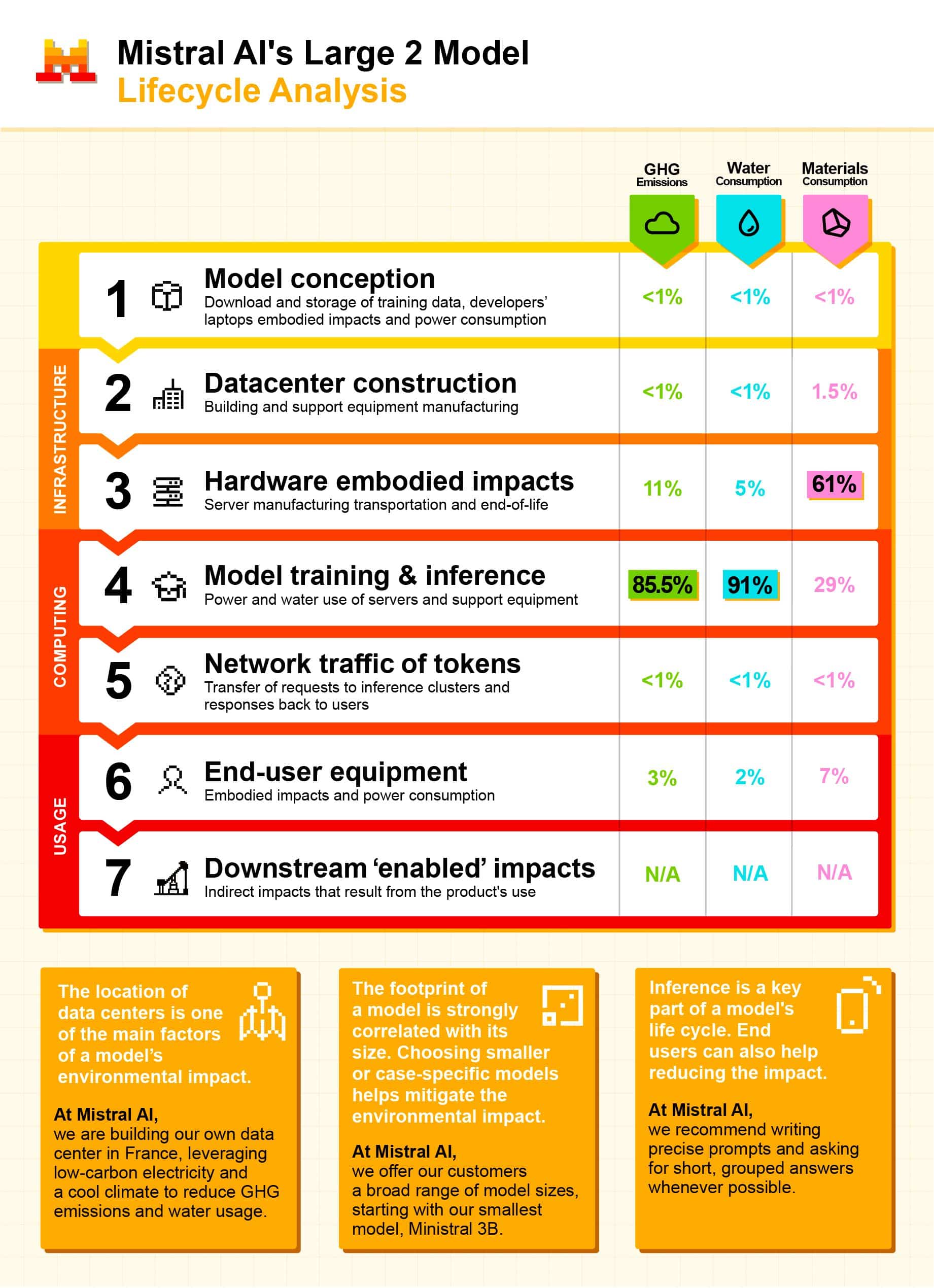
The study conducted by Mistral in cooperation with sustainability consultancy Carbone 4 and the French environmental agency ADEME is the first of its kind. It analyzes the entire life cycle of an LLM and provides concrete figures for three central environmental impact categories:
- Greenhouse gas emissions: Measured in CO₂ equivalents (CO₂e).
- Water consumption: Measured in cubic meters (m³).
- Resource consumption: Measured in antimony equivalents (Sb eq), a standard measure for the consumption of non-renewable raw materials.
The two most important results of the study are:
The Footprint of Training:
The 18-month training of Mistral Large 2 generated 20.4 kilotons of CO₂e, consumed 281,000 m³ of water and 660 kg Sb eq of resources. Crucially, these figures include not only the energy consumption of the GPUs, but also “upstream emissions” – i.e., the environmental impacts from the manufacture of servers, cooling, and other infrastructure.
The Footprint of Usage (Inference):
A single, average query to the model (approx. 400 tokens) causes 1.14 gCO₂e, 45 ml of water and 0.16 mg Sb eq.
Key Findings and the Path to a Standard
Beyond the pure numbers, the study provides important insights for the entire AI industry. The analysis shows a strong correlation between model size and ecological footprint. A model that is ten times larger tends to produce ten times higher environmental impacts for the same task.
The authors emphasize that the study is a “first approximation,” as there is still a lack of established standards and publicly available data, particularly on the environmental balance of GPUs.
Based on their findings, Mistral proposes a path to more transparency and sustainability:
- Standardized metrics: To make models comparable, three indicators should be the focus: the absolute impacts of training, the marginal costs of inference, and the ratio of total inference impacts to the entire life cycle.
- Development of industry standards: The industry should work together on internationally recognized frameworks. This could lead to the creation of a scoring system that helps users identify the most resource-efficient models.
- Publication of data: Mistral commits to making the results available in the public database “Base Empreinte” of ADEME and thus creating a reference point for future analyses.
Conclusion: A Crucial Step for Sustainable AI
The study presented by Mistral AI is more than just an environmental balance. It is a fundamental contribution to the urgently needed transparency in the AI sector. By disclosing concrete, traceable data for a top model, a basis is created for an informed discussion about the sustainability of artificial intelligence. The results show that the environmental impacts are significant, but also that they can be influenced through efficiency and choosing the right model. This pioneering work is a crucial first step in aligning the explosive growth of AI technology with global climate goals.
Source: https://mistral.ai/news/our-contribution-to-a-global-environmental-standard-for-ai