

We are at the beginning of a new era: AI agents are fundamentally changing our business and everyday world. But what exactly is behind this term, and why should you as a leader be concerned with this topic?
What is an AI Agent?
An AI agent is an intelligent software program that independently interacts with its environment, collects data, and based on that independently makes decisions to achieve predefined goals. Unlike conventional software, which works strictly according to fixed rules, AI agents learn from experience and adapt their strategies – similar to a human employee, but with the speed and precision of a machine. They use modern Large Language Models (LLMs) and are connected to your existing enterprise software through interfaces.
How Do AI Agents Work?
An AI agent typically goes through three steps:
Goal Setting: The agent receives a specific goal that it should achieve. These goals can be divided into subtasks for different personas of the AI agent.
Data Acquisition: It collects relevant information from its environment or internal databases.
Action Execution: Based on the collected data, the agent independently decides on the necessary steps and implements them optimally to achieve the goal. It can communicate with its environment via APIs and repeatedly perform actions.
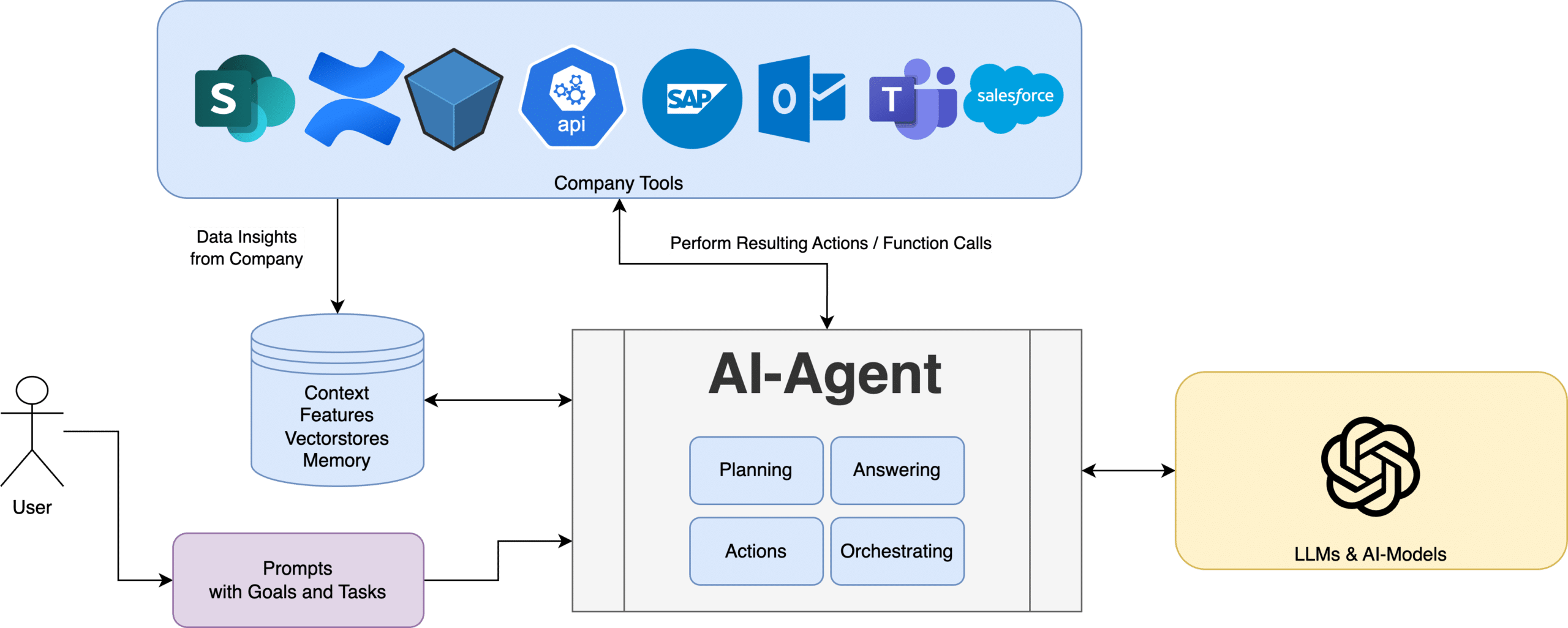
This autonomous approach enables AI agents to respond flexibly and efficiently to different situations. The more data sources they can query or access, the more productive tasks they can take over within your company. However, this requires good data sources and APIs.
Why Are AI Agents Relevant for Your Company?
The integration of AI agents is the next logical step after the introduction of language models like (Chat)GPT – CompanyGPT – in the enterprise context.
The Key Benefits for Companies Are:
- Increased Efficiency and Productivity: AI agents take over monotonous and time-consuming tasks so your employees can focus on creative and strategic activities. This leads to optimal use of resources and increases the overall productivity of your team.
- Optimization of Internal Processes: AI agents can be deeply integrated into your company. For example, you can develop agents that monitor and optimize production processes or machines, leading to cost savings and higher quality.
- Personalized Customer Experiences: AI agents analyze customer behavior in real-time, recognize preferences, and offer tailored solutions. This sustainably increases the satisfaction and loyalty of your customers.
- Fast Decision-Making: With the ability to analyze large amounts of data in real-time, AI agents provide valuable insights and forecasts. This allows you to make informed decisions and respond more quickly to market changes.
Simply put, you can train AI agents to pursue goals in your company from different perspectives and achieve them within the scope of possibilities (data and interfaces).
Challenges and Solutions
With all the benefits, there are also challenges to consider:
- Data Protection & AI Compliance: Processing large amounts of data requires responsible handling of sensitive information. Make sure you comply with legal requirements and implement transparent data protection policies.
- Ethical Considerations: AI agents should be designed to make fair and unbiased decisions. Regular reviews and human oversight are essential here.
- Technical Complexity: Implementation requires expertise. Invest in qualified employees or cooperate with experienced partners to make the transition smooth.
- Missing Interfaces and Data Sources: An agent is only as good as the data sources and APIs it can access. If your company has many data silos and only a few actions are executable via API, implementation is more complex.
Is Your Company Ready for AI Agents?
AI agents are more than just a technological trend – they are a crucial step to effectively link AI models with your business processes. Before implementing AI agents, you should clarify the following questions:
1. What Data Does My AI Agent Need to Work Effectively?
Identify relevant data sources such as customer data, production figures, or market analyses. Make sure this data is current and of high quality.
2. Is This Data Sensitive or Subject to Special Confidentiality?
Check data protection policies and internal classifications. Your AI agent should only access permissible data.
3. Are There Interfaces to Access This Knowledge?
A central knowledge database simplifies data access. If knowledge is scattered, you should introduce a knowledge management system.
4. Are Our Core Processes Digitized and Controllable via API?
The digital transformation of your business processes is a prerequisite for integrating AI agents. APIs enable seamless integration into existing systems.
5. Which Stakeholders Need to Be Involved?
Identify relevant departments and establish approval processes. Clarify which manual quality gates are required.
6. Where and How Should the AI Agent Be Executed?
Decide whether deployment should be in the cloud, on-premises, or hybrid. An existing cloud strategy can often be extended to include an AI strategy.
7. What AI Competencies Does My Company Have and How Can They Be Expanded?
Evaluate internal know-how and plan training or hiring of experts. A competent team is crucial for success.
8. Do We Meet GDPR Requirements and Do We Need Special Documentation?
Make sure data processing is legally compliant. Check whether your AI agents fall under the EU AI Regulation (AI Act).